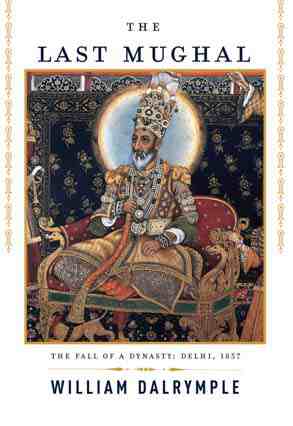
The Last Mughal by William Dalrymple has to be one of the most engaging and engrossing historical account of the great Indian mutiny of 1857. The book sensitively handles the issue with a balance approach in terms of the references.
Keeping in mind the local sensibilities Dalrymple relied on an impressive list of sources, including people from Zafar's court and other royals. So you have manuscript sources in European languages, unpublished manuscripts and dissertations, Persian and Urdu sources, contemporary works and articles in European languages, and secondary works and periodical articles being referred to every now and then by the author.
To make life easy for a history student, throughout the book Dalrymple gives the source name and the page number to authenticate his claim.
There are several things that saddens one after reading the book. The one that glares out from the rest is the way the great Mughal capital was treated. Delhi once a city of art, beauty, culture, and a symbol of Hindu-Muslim unity was robbed of everything it stood for. The Indian rebels were as much to blame for the city's loss as were the British.
You could share the grief of the Bahadur Shah Zafar as the helpless soul who saw his sons and empire going down in front of his eyes. The once a peaceful and poetic city was turned into a mass graveyard with bodies rotting in the open, and destruction all around. Many great poets of the era lost their lives and rare poetic work lost. Worse was the treatment of the emperor Zafar. He was exiled to Rangoon, confined to a small house with a handful of loyal followers, his death a hush-hush affair, and his place of burial kept a secret for 129 years till it was accidentally discovered.
And you won't miss the fact that we lost a great cause and the war due to a complete lack of discipline and unity.
Dalrymple work gives you a beautiful glimpse into the life and times of the great Mughal during his last few years. The fight for succession, influence of a eunuch, poet as court members, celebration of Hindu festivals with equal fervour, a royal wedding of monumental scale, old world charm of a flourishing city, Dalrymple's has woven it all seamlessly. History has rarely been this fascinating!
Dalrymple introduces the main characters in a separate section before the actual book, and that makes his narrative easy to follow. When it comes to Bahadur Shah Zafar, Dalrymple gives a very poignant account bordering on pity at times. But it is his love for the city of Delhi that you won't miss throught the novel. Maybe that's why his family divide their time between Delhi, London, and Scotland.
This one para more or less summarises the whole book-
"He (Zafar) is blamed by some nationalist historians for corresponding with the British during the fighting, and by others for failing to lead the rebels to victory. Yet it is difficult to see what more Zafar could have done, at least at the age of eighty-two. He was physically infirm, partially senile and had no money to pay the troops who flocked to his standard. Octogenerians can hardly lead a cavalry charge. Try as he might, he was powerless even to stop the looting of Delhi by an insurgent army that proved almost as much a threat to Zafar's subjects as it did to his enemies. Yet the Mutiny Papers bear eloquent witness to the energy he expended trying to protect his people and his city."
The reality will bite you at times but didn't they say, "everything is fair in war." A must read book for all the history lovers.
 This should have been the post before 'The Last Moghul.' Anyway, I finished reading Ibn Hesham's "The Prophet's Biography" couple of months back. It is a revised and abridged version of the earliest work on the subject by Mohammad Ibn Ishaq Al Matlabi.

