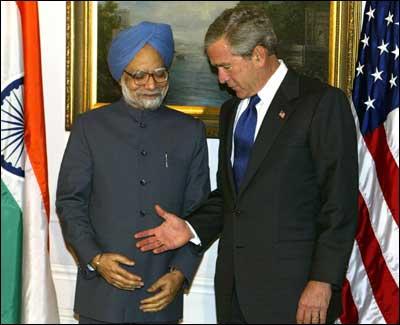
 The Indo-US nuclear deal has generated a lot of media interest and political upheaval in India. As I surfed through web pages dedicated to the deal, there were some expert opinions worth sharing. But first a quick quick roundup of the deal-
1. India agrees to allow inspectors from IAEA to access its civilian nuclear program. India has promised to keep all future (and many exisiting) civilian thermal and breeder reactors under the IAEA safeguards.
2. India agrees to continue halting its nuclear weapon testing and commits to increased security of its nuclear arsenals.
3. US companies will be allowed to build nuclear reactors in India.
4. India works with US towards negotiating the Fissile Material CutOff Treaty, which calls for banning the production of fissile material for weapons purposes, with the US.
And now the comments-
"The bilateral agreement signed in August 2007, arising from the deal but yet to be approved by the US Congress, allows nuclear trade between the two parties and "also, where appropriate, trade between third countries and either party of items obligated to the other party." The trade is envisaged in nuclear material or fuel, related technology and equipment. The trade in fuel, which is uranium, can only tie India and its energy program to an international cartel, notorious for its price manipulation practices. Representatives of the uranium producers of Canada, Australia, France, South Africa and the UK formed a secret cartel after confabulations in Paris in 1972. This led to the great uranium scam soon in the US, with Westinghouse House Electric becoming a victim of the cartel. The company, the largest US manufacturer of reactors, signed contracts to supply cheap uranium to utilities which bought its reactors and failed because of that cartel's price-fixing practices, standing to lose billions in the bargain. The cartel got away with the connivance of the governments of the five countries as well as the US."
"The cartel's exposure did not change its conduct. The price of this precious metal, better known in the market in the powdered product called yellowcake, has always remained viciously volatile. Over the past five years, the international spot price of uranium has spiraled faster than that of crude oil, with its price now hovering six times above its long-term average of $10 a pound."
"In January 2005, seven months before the deal was struck, a sharp rise in uranium prices was predicted. The uranium market, experts agreed, had become a classic "seller's market."
"The prediction proved right. Between 2004 and 2007, the spot price of uranium more than quadrupled. According to an assessment made in June 2008, the nuclear construction program in India and China is likely to result in a 58 percent uranium price rebound. Such price fluctuations are not what exactly the doctor would order for a developing economy."
---J. Sri Raman, freelance journalist and a peace activist
"Rather than integrating India into the nonproliferation mainstream, the proposed deal would set a risky double standard that would shatter the delicate bargain upon which the global nonproliferation regime is based."
"In addition, by increasing India's capability to produce nuclear weapons, the deal will exacerbate an already perilous nuclear arms race in South Asia, because Pakistan is likely to respond by expanding its own nuclear capability."
"The Bush administration's desire to complete the deal before it leaves office cannot be allowed to come to fruition at the expense of key U.S. nonproliferation objectives. The deal should be left to the next administration and the next Congress, where, we hope, its numerous shortcomings will be remedied."
---Leonor Tomero, Director of Nonproliferation, Centre for Arms Control and Nonproliferation, Washington
“I do not share his (Manmohan Singh) view that this deal is so important to India that it is worth sacrificing everything for. But I do not dispute that his view stems from his conception of national interest."
"And I think he is playing this all wrong."
"He is coming off as a man who is prepared to martyr his party at the altar of his own beliefs while he heads off to some high-minded retirement.” ---Vir Sanghvi, editorial director, Hindustan Times
"On balance, the India-US nuclear deal as proposed is the much-needed recipe to regenerate our nuclear establishment that is stifling under present international regulations. If the status quo is allowed to prevail, our ambitious plan for nuclear power will not only remain a pipedream but even the status quo will become unsustainable as Indian nuclear fuel sources are limited and of inferior quality that make it more costly."
---Indrajeet Rai, Zee News
"For Singh, who like many Indians sees China as much a rival and potential danger as an opportunity, a strengthened relationship with Washington is the natural route to security."
"Bush's offer is extraordinarily generous. India will be quietly recognized as a nuclear weapons power, its past sins of defiance of the international non-proliferation regimes will be consigned to diplomatic amnesia."
"India is only being asked to put its civilian nuclear reactors -- not its weapons program -- under international regulation. In return, Washington says it will back India in negotiating a special deal with the International Atomic Energy Agency (IAEA) and the Nuclear Suppliers Group."
---Jonathan Manthorphe, Vancouver Sun
"We need a supply of uranium till our thorium reactors are ready. The pact will help us."
---Abdul Kalam, Financial Express
"The nuclear power generation (NPG) is currently about 3% of total power generation in the country and with this agreement which will involve transfer of technology, as well as continuity of fuel(Uranium) the share of NPG will go to about 6 -7% by 2020 by importing 12 Reactors probably from the West with a total capacity of 12,000 MW."
"It will be a turn key operation about which India has always had bad experience. Turn key operations in the power sector have historically never generated in-house expertise..."
"There is no need to put such a great emphasis on nuclear energy as if the country's future depended on it. We need to build good expertise in all aspects of power by focusing on modern technological aspects as well as investing in alternative energy sources. The nuclear aspect of the deal can wait but the greater technological cooperation between the countries must be given priority."
---M A Pai, Professor Emeritus, Department of Electrical and Computer Engineering, Univ of Illinois


